
Isobaric Energy Recovery Desalination: Efficiency Gains Explained




For seawater RO projects, energy use still shapes both technical feasibility and long-term water cost. That is why isobaric energy recovery desalination receives so much attention. It reduces the burden on high-pressure pumping by transferring pressure from concentrated brine to incoming feedwater, helping plants cut specific energy consumption without sacrificing stable operation.
This matters well beyond equipment selection. In industrial water treatment, desalination developers, EPC teams, and asset owners increasingly judge systems by efficiency per cubic meter, operating resilience, and lifecycle economics. Within that decision framework, isobaric energy recovery desalination is no longer a niche upgrade. It is often a core design variable.
Why pressure recovery has become central
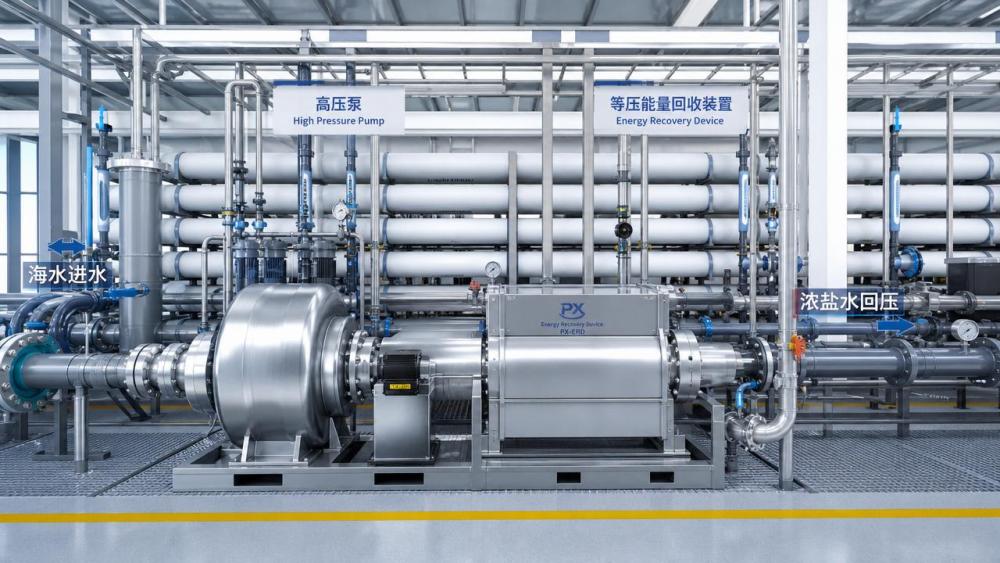
Seawater reverse osmosis operates at very high pressure, often around 60 to 80 bar depending on salinity, temperature, and recovery targets. A large share of input energy is tied to creating that pressure.
After membranes separate permeate from brine, the reject stream still contains substantial hydraulic energy. If that energy is throttled away, the plant loses a major opportunity for efficiency improvement.
Isobaric energy recovery desalination addresses this directly. Instead of converting pressure into mechanical rotation with larger losses, it transfers pressure almost directly between two fluid streams. That simple idea changes plant economics in a very practical way.
In today’s market, that benefit aligns with broader industrial priorities. Lower electricity demand supports LCOW reduction, carbon management, power infrastructure sizing, and more predictable operating budgets.
How isobaric energy recovery desalination works in practice
At the process level, the concept is straightforward. High-pressure brine leaving the membrane array enters an energy recovery device. Inside that device, its pressure is transferred to a portion of incoming seawater.
The feedwater then reaches near-membrane pressure before entering the RO train. A booster pump usually provides only the remaining pressure difference and compensates for hydraulic losses.
This is why isobaric systems differ from older turbine-based recovery approaches. The energy path is shorter, pressure transfer efficiency is higher, and the load on the main high-pressure pump falls materially.
In well-designed systems, the result is lower kWh per cubic meter, smoother pressure control, and improved fit for large seawater RO facilities where energy dominates OPEX.
What changes at plant level
- The main high-pressure pump can be smaller or operate under lower net duty.
- Specific energy consumption typically drops compared with systems lacking modern recovery devices.
- Hydraulic stability can improve when the device is matched correctly to flow and recovery rate.
- Lifecycle cost becomes easier to justify in projects sensitive to energy price volatility.
Where the efficiency gains really come from
The efficiency story is not only about one component. It comes from how pressure transfer reshapes the entire RO balance. Less wasted pressure means less reliance on electrical input to recreate the same hydraulic condition.
That effect becomes more valuable as plant size increases. In high-capacity desalination, even small improvements in recovery device efficiency can produce meaningful annual savings.
More importantly, the gain is measurable in business terms. Lower energy demand affects operating expenditure, backup power requirements, cooling demands around motor systems, and sometimes even transformer sizing.
For projects tracked through ESG or decarbonization metrics, isobaric energy recovery desalination also contributes to lower indirect emissions per unit of produced water. That is becoming a more visible decision factor in industrial and municipal procurement.
Why the topic matters across industries
The value of isobaric energy recovery desalination is not limited to coastal drinking water projects. Industrial users facing water scarcity, discharge limits, or production expansion increasingly depend on desalination as part of broader water strategy.
In mining, chemicals, power generation, and lithium processing, seawater or saline source treatment may be linked with reuse systems, pretreatment trains, and downstream concentration processes. In such settings, energy recovery affects the economics of the entire water infrastructure.
That broader context explains why intelligence platforms such as IWTS focus on the connection between membrane science, fluid dynamics, fouling control, compliance pressure, and total project return. Energy recovery is not an isolated feature. It sits inside a system-level decision.
When teams compare desalination options, they now look beyond nameplate capacity. They want to understand how pressure management, membrane protection, pretreatment quality, and energy recovery work together over years of operation.
What should be checked during technical evaluation
A useful review starts with the real operating envelope, not the headline efficiency value. Isobaric energy recovery desalination performs best when the device is assessed within the actual salinity range, temperature variation, and recovery target of the project.
Attention should also stay on pretreatment quality. Suspended solids, biofouling potential, and scaling precursors do not only threaten membranes. They can affect pressure exchanger reliability and maintenance frequency as well.
It is also worth checking how the supplier reports efficiency. Some figures describe peak conditions. Others reflect system-level operation after accounting for booster pumps, valves, and control losses.
Key questions that sharpen comparison
- How does performance change during part-load operation or seasonal seawater variation?
- What is the expected maintenance interval under the intended pretreatment regime?
- How much of the stated saving appears at full system level, not just at device level?
- What monitoring points are available for pressure, leakage, and performance drift?
- How does the device integrate with membrane staging and future capacity expansion?
Common misunderstandings and practical limits
One common mistake is to treat isobaric energy recovery desalination as an automatic guarantee of low OPEX. The device can be highly efficient, yet the plant may still underperform if pretreatment is weak or membrane fouling drives up operating pressure.
Another issue is over-focusing on the recovery device while ignoring control strategy. Flow balance, pressure pulsation management, and booster pump selection still matter. System integration determines whether theoretical efficiency becomes realized efficiency.
There is also a commercial dimension. The best choice is not always the device with the most impressive specification sheet. It may be the option with stronger serviceability, clearer performance data, and better compatibility with local operating conditions.
In other words, the technology should be judged within LCOW, uptime expectations, and compliance risk rather than on one efficiency number alone.
A practical next step for project screening
A sound next step is to build a comparison sheet that links recovery device data with the full RO design basis. Include feed salinity, design pressure, recovery ratio, membrane arrangement, pretreatment quality, specific energy consumption, and maintenance assumptions.
That approach makes isobaric energy recovery desalination easier to judge in real project terms. It moves the discussion from broad claims to evidence on efficiency, stability, and lifecycle fit.
For anyone tracking seawater RO trends through IWTS, the most useful perspective is integrated rather than component-level. Pressure recovery should be reviewed alongside membranes, pumps, fouling control, compliance pressure, and capital efficiency.
When those factors are examined together, isobaric energy recovery desalination becomes easier to understand for what it really is: a high-impact design decision that can strengthen both technical performance and long-term water economics.
Related News
- How seawater salinity shapes desalination engineering in Saudi ArabiaSep 21, 2026Prof. Kaelen Sterling
- Why Does High-Pressure Pump Efficiency Drop in High-Salinity RO Systems?Sep 09, 2026Prof. Kaelen Sterling
- Cooling Feedwater Treatment Problems That Trigger Scaling FastJul 11, 2026Prof. Kaelen Sterling
- Latent Heat Recovery in Evaporation Systems: Where Efficiency Gains Come FromJun 29, 2026Prof. Kaelen Sterling
Related News
- 00
0000-00
What drives operating costs in ultrafiltration membrane systems? - 00
0000-00
Shilong Wastewater Plant Expansion to Add 20,000 Cubic Meters of Daily Capacity - 00
0000-00
Is water treatment energy management worth the upfront cost? - 00
0000-00
Hainan University Team Reports Breakthrough in Continuous Electrocatalytic Desalination - 00
0000-00
How solids loading affects filtration costs in lithium extraction
Weekly Insights
Stay ahead with our curated technology reports delivered every Monday.