
Turbine Energy Recovery in SWRO: Payback Basics




For SWRO projects, energy recovery is no longer a secondary optimization. It sits close to the center of plant economics, because power cost often shapes both water price and long-term asset value.
That is why turbine energy recovery desalination deserves attention beyond the process room. It affects operating expenditure, payback timing, carbon intensity, and the credibility of efficiency claims used in project evaluation.
In practical terms, the question is simple: how much pressure energy can be captured from SWRO brine, and how fast can that recovered value repay the installed equipment cost?
Why turbine energy recovery matters in SWRO
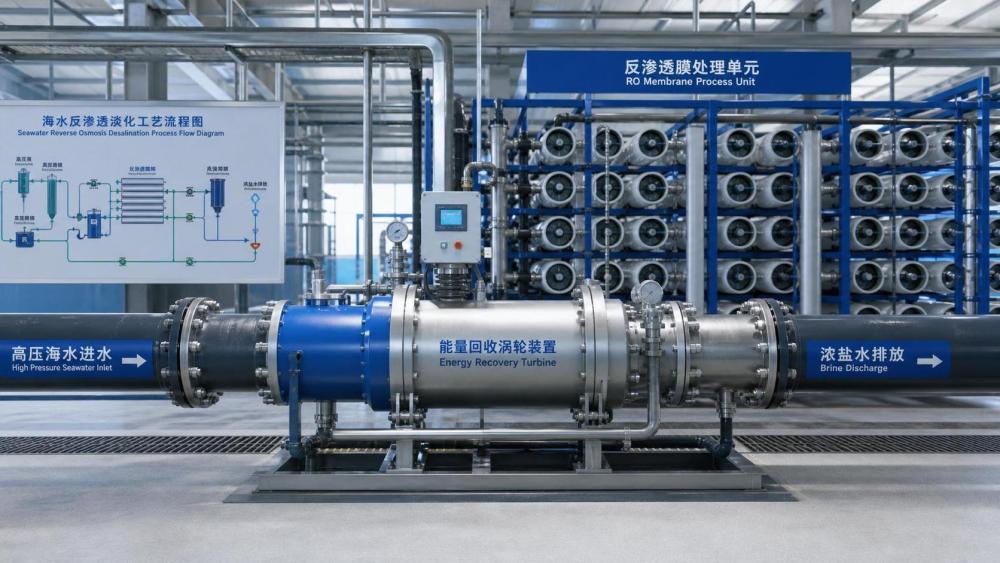
Seawater reverse osmosis operates under high pressure. After permeate is separated, the remaining brine still carries substantial hydraulic energy that would otherwise be wasted.
Turbine energy recovery desalination uses that residual pressure to reduce the net power demand of the SWRO train. The recovered energy can support feed pumping or offset high-pressure pumping load.
This matters more when electricity tariffs rise, recovery targets tighten, or water purchase agreements reward lower lifecycle cost. In those conditions, even modest efficiency gains can reshape project competitiveness.
Across industrial water treatment, the same logic appears repeatedly: wasted energy becomes an avoidable cost. IWTS follows this theme across desalination, ZLD, filtration, and wastewater reuse because efficiency increasingly drives investment quality.
The payback logic behind the technology
Payback is not only a technical number. It is a commercial translation of fluid dynamics into board-level language.
A turbine-based system adds capital cost, integration work, controls, piping adjustments, and maintenance obligations. In return, it cuts specific energy consumption, usually measured per cubic meter of produced water.
The basic equation is straightforward. Annual energy savings are compared with total installed cost, while downtime risk, service intervals, and operating profile influence the real outcome.
For turbine energy recovery desalination, the best payback cases usually combine high throughput, stable operation, high pressure, and expensive electricity. Plants with variable loading may still benefit, but the savings model needs more caution.
A short payback can look attractive on paper, yet a stronger measure is lifecycle value. If the device protects energy intensity over many years, the project benefit extends well beyond the first recovery period.
What usually enters the calculation
- Plant capacity and annual operating hours
- Feed salinity, design pressure, and recovery rate
- Actual energy consumption before recovery installation
- Local electricity price and expected escalation
- Installation cost, controls, and commissioning scope
- Maintenance cost and equipment availability
Where industry attention is shifting
The market is no longer satisfied with generic efficiency claims. Decision quality now depends on how clearly suppliers and project teams connect technology choice with LCOW, ESG targets, and operational resilience.
This is especially relevant in regions where desalination supports mining, power generation, refining, chemicals, and municipal supply under water stress. In those sectors, energy cost volatility directly changes the cost of secure water.
Turbine energy recovery desalination is part of a broader performance conversation that also includes membrane fouling control, pump efficiency, pretreatment reliability, and overall plant automation.
A weak pretreatment system can erase expected savings. If fouling increases pressure demand, the energy baseline shifts, and recovery performance may not match the original business case.
That is one reason IWTS frames desalination within a wider industrial water treatment context. Payback is strongest when the whole process line is evaluated, not when one component is assessed in isolation.
Typical plant situations where payback is easier to justify
Not every SWRO installation will show the same return profile. Some conditions make turbine energy recovery desalination easier to support financially and technically.
In these cases, the discussion often moves quickly from “Does it work?” to “How should the return be modeled?” That is a more useful stage of evaluation.
What can distort the payback estimate
The most common mistake is assuming design conditions will match real operation all year. Few plants operate at nameplate conditions every day.
Seasonal seawater temperature, membrane aging, fouling, pretreatment instability, and pump efficiency drift all affect system energy balance. A payback model that ignores them may look polished but remain unreliable.
Another issue is incomplete scope costing. Turbine energy recovery desalination may require more than the device itself, including piping changes, pressure control logic, instrumentation, and operator training.
It is also worth checking maintenance assumptions. If spare parts, service response, or installation quality are weak, financial return can slip even when theoretical efficiency remains sound.
Useful questions during review
- Is the savings model based on design data or real operating history?
- How sensitive is payback to electricity price changes?
- What happens if membrane differential pressure rises?
- How much downtime is assumed for service events?
- Does the retrofit affect upstream or downstream process stability?
How to interpret turbine energy recovery desalination in a broader water strategy
The value of energy recovery becomes clearer when water strategy extends beyond one plant item. Many industrial operators now compare desalination not only by output quality, but also by energy intensity, reuse potential, and compliance resilience.
That broader view links SWRO decisions with pretreatment filtration, wastewater reclamation, discharge reduction, and even ZLD planning. Lower energy consumption in one part of the chain improves total water infrastructure economics.
This is where intelligence platforms such as IWTS add practical value. Technology comparison is more credible when pressure recovery, membrane science, fouling behavior, and project ROI are examined together.
In other words, turbine energy recovery desalination should not be treated as an isolated gadget. It is part of the discipline of building lower-TCO water systems with stronger environmental performance.
A sensible next step for project evaluation
A useful next step is to build a site-specific payback screen before moving into detailed procurement. The screen should combine real operating data, expected energy savings, integration cost, and sensitivity to power price shifts.
It also helps to compare turbine energy recovery desalination against the wider efficiency stack: pump upgrades, pretreatment stabilization, membrane replacement strategy, and control optimization.
When those factors are reviewed together, the decision becomes less about chasing a headline efficiency figure and more about securing dependable water production at a lower lifecycle cost.
That is the right context for judging payback basics: not as a narrow equipment calculation, but as a disciplined way to test whether recovered pressure can create durable business value in SWRO.
Related News
- What to verify before choosing a seawater RO technology supplierSep 11, 2026Osmotic Pressure & Membrane Architect
- When containerized RO desalination systems make sense in Saudi ArabiaAug 19, 2026Osmotic Pressure & Membrane Architect
- What Drives Seawater RO Technology Cost in Containerized SWRO Projects?Aug 13, 2026Osmotic Pressure & Membrane Architect
- How to Compare Desalination Systems for Municipalities by Lifecycle CostJul 14, 2026Osmotic Pressure & Membrane Architect
Related News
- 00
0000-00
How to verify industrial discharge compliance requirements before a permit renewal - 00
0000-00
How seawater salinity shapes desalination engineering in Saudi Arabia - 00
0000-00
How to compare water treatment EPC contractors by lifecycle cost - 00
0000-00
When does industrial wastewater reclamation for reuse justify its cost? - 00
0000-00
When turbocharger energy recovery technology reduces MVR power demand
Weekly Insights
Stay ahead with our curated technology reports delivered every Monday.