Which mine tailings water treatment process fits your site conditions?




Selecting the right mine tailings water treatment process depends on more than discharge limits. The practical decision sits at the intersection of tailings chemistry, flow variability, water recovery objectives, available footprint, energy access, sludge handling, and long-term compliance exposure. Thickening, clarification, filtration, membrane systems, evaporation, and zero liquid discharge can all be valid choices—but only when they are matched to the ore body, the operating regime, and the mine’s lifecycle cost objectives.
The most expensive mistake is to select treatment equipment from a generic process diagram before the water and solids behavior have been properly characterized. A process that performs well on a copper concentrator with relatively stable reclaim water may fail economically at a gold operation with seasonal rainfall, elevated cyanide-related compounds, or highly variable suspended solids. In mine tailings water treatment, the correct answer is rarely a single technology. It is usually a treatment train designed around the constraints that cannot be negotiated.
Begin with the water balance, not the equipment list
A tailings water treatment decision should start with a site-wide water balance covering normal production, wet-season conditions, upset conditions, closure planning, and potential expansion. Treatment capacity based only on an average daily flow often becomes inadequate when thickener overflow quality changes, a tailings storage facility receives stormwater, or ore characteristics shift.
The key question is not simply “how much water is generated?” It is “which water streams require which quality standard?” A mine may have several distinct streams:
- thickener overflow suitable for direct recycle after clarification;
- tailings pond reclaim water with elevated suspended solids or dissolved salts;
- seepage and contact water requiring containment and treatment;
- workshop, camp, or domestic wastewater that should not be mixed unnecessarily with high-salinity process water;
- stormwater that may be clean, contaminated, or intermittently affected by operations.
Combining all streams into one large treatment plant can simplify piping on paper, but it often raises both capital and operating cost. Segregation allows lower-cost water to be reused directly and reserves advanced treatment for the fraction that genuinely needs it. This principle becomes especially important where reverse osmosis, evaporation, or crystallization is under consideration, because every unnecessary cubic meter sent to those units increases energy use, chemical consumption, and concentrate-management requirements.
Water balance work also needs a realistic view of storage. If a site has sufficient pond capacity to buffer short-duration high flows, treatment equipment may be designed for a steadier rate. If storage is constrained by dam safety, permit conditions, climate, or site footprint, the plant must absorb larger hydraulic peaks. That difference can reshape the entire process selection.
Tailings chemistry determines the treatment ceiling
Suspended solids are visible and often receive the most attention, but dissolved constituents usually determine whether a mine can meet reuse or discharge targets at a reasonable cost. A complete characterization program should consider more than pH, turbidity, total suspended solids, and conductivity. Depending on the ore and process route, the decision may turn on sulfate, chloride, hardness, silica, iron, manganese, arsenic, selenium, fluoride, ammonia, nitrate, thiocyanate, cyanide species, residual flotation reagents, hydrocarbons, or dissolved metals.
Equally important is the variability of these parameters. One sample from a pond or thickener overflow is not a sound basis for design. Ore blending, reagent changes, seasonal evaporation, fresh-water make-up quality, and recycle accumulation can materially change the water chemistry over time. A treatment train should be selected against expected operating ranges and credible worst-case conditions rather than a laboratory average.
High total dissolved solids are particularly consequential. Clarification and conventional media filtration can remove solids but do not reduce dissolved salinity. If reclaimed water becomes progressively more saline in a closed or semi-closed circuit, it may affect flotation performance, scaling risk, corrosion, reagent consumption, or product recovery. This is the point at which a mine must distinguish between water treatment for solids removal and water treatment for dissolved-ion control.
Where dissolved metals or metalloids drive compliance risk, chemical precipitation may be a practical core process. Lime, caustic soda, sulfides, ferric salts, or other reagents can be used in carefully controlled applications, but the resulting sludge volume and stability must be included in the decision. Treating dissolved contaminants by creating a difficult hazardous or metal-bearing sludge is not a complete solution unless the site has a defensible handling and disposal route.
Choose the primary solids-removal route according to tailings behavior
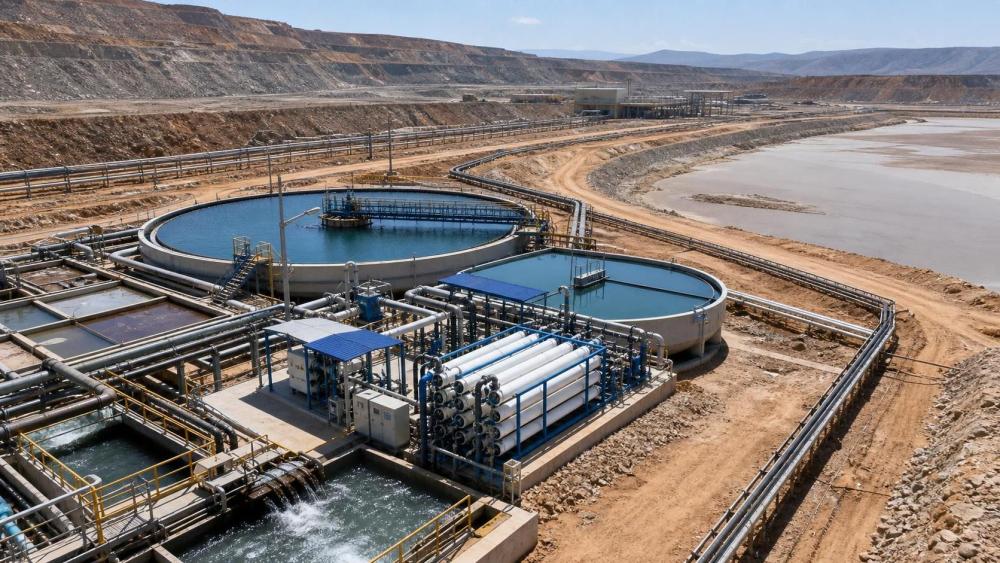
For many operations, the greatest water recovery gains are achieved upstream through better thickening, clarification, and solids separation rather than through downstream polishing equipment. If the tailings stream contains recoverable water entrained in slurry, improving dewatering performance can reduce the load on every later treatment stage.
High-rate thickening and clarification are generally appropriate when the main objective is to recover relatively clear process water from mineral slurries or pond reclaim water. Their performance depends heavily on flocculant selection, feed solids characteristics, pH, shear exposure, and settling behavior. A thickener that performs adequately during commissioning may lose clarity when ore mineralogy changes or fine-clay content increases. Bench and pilot tests should therefore include representative ore blends, not only a single favorable sample.
Paste thickening and filtration are relevant when water recovery, tailings storage footprint, or dam-risk reduction justify a higher degree of dewatering. Belt filters, vacuum filters, pressure filters, and filter presses have different tolerance for particle size distribution, clay content, throughput variation, and required cake moisture. These systems can materially reduce water locked in tailings, but they introduce mechanical availability, cloth washing, consumable, and materials-handling considerations. Their value is strongest where dry-stack or filtered-tailings strategies are already part of the site plan, rather than as an isolated water-treatment upgrade.
Hydrocyclones and centrifuges can support classification or solids concentration in specific duties, but they should not be assumed to replace clarification for ultra-fine particles. Fine clays and colloidal material often remain the limiting factor. In those cases, coagulation, flocculation, lamella clarification, dissolved air flotation in selected applications, or membrane pretreatment may be needed.
The practical selection criterion is water quality after separation, not just the percentage of solids removed. Water destined for grinding or dust suppression may tolerate more residual solids than water feeding membranes, boilers, reagent preparation, or high-pressure pumps. Designing all recovered water to the highest purity requirement is usually an unnecessary cost burden.
When membranes are justified—and when they are not
Ultrafiltration and microfiltration are useful where stable low-turbidity water is required, particularly as pretreatment for reverse osmosis or where fine suspended solids would interfere with downstream reuse. They are not a substitute for robust upstream solids management. Sending poorly clarified tailings water directly to membranes commonly results in rapid fouling, excessive cleaning frequency, high replacement costs, and unreliable production.
Reverse osmosis becomes relevant when dissolved salts, hardness, sulfate, or specific dissolved contaminants prevent internal reuse or compliant discharge. It can produce high-quality permeate, but it creates a concentrate stream that must be managed. That concentrate is often the decisive issue in inland mining regions with no feasible marine outfall and limited disposal capacity.
RO selection should therefore be evaluated as a complete system: pretreatment, cartridge filtration or ultrafiltration, antiscalant strategy, cleaning provisions, membrane replacement, brine volume, brine chemistry, and final concentrate disposition. Recovery targets should not be pushed to the highest theoretical level if doing so makes scaling control fragile or transfers an unmanageable burden to evaporation.
Membrane projects are most defensible where feed quality is reasonably controlled, the recovered water has clear operational value, and concentrate has a permitted, technically credible outlet. They are less attractive where feed chemistry fluctuates sharply, power reliability is poor, or the mine has not resolved how the reject stream will be stored, treated, reused, or disposed of through the full operating life.
Evaporation and ZLD solve a disposal problem, but at a premium
Evaporation, mechanical vapor recompression, crystallization, and zero liquid discharge configurations are increasingly considered where discharge restrictions are tightening, water scarcity is acute, or brine disposal options are limited. These systems can maximize water recovery and convert liquid residues into solids for handling. They can also be among the most capital-intensive and energy-demanding components of a mine water strategy.
They should not be treated as a default response to difficult water. The decision depends on the volume requiring treatment, salinity, scaling tendency, available heat or electricity, reagent requirements, local climate, labor capability, spare-parts access, and the nature of the final salt or mixed-solid residue. A ZLD system that produces solid waste still requires a secure disposal pathway; “zero liquid” does not mean “zero environmental obligation.”
Evaporation may be technically attractive when RO concentrate volumes are modest, when waste heat is available, or when water reuse has exceptional value. It is far harder to justify as the first treatment step for a large volume of moderately contaminated tailings water. In many cases, a better approach is to maximize thickener recovery, segregate clean and dirty streams, remove metals or solids selectively, apply RO only to a targeted side stream, and send the reduced brine volume to thermal treatment.
Do not overlook sludge, scale, and residue logistics
Mine water treatment proposals can look efficient until the secondary waste streams are quantified. Clarifiers generate underflow. Metal precipitation produces hydroxide or sulfide sludge. Membrane systems generate concentrate. Evaporators and crystallizers generate salts, mixed solids, or scaling deposits. Each residue has different transport, storage, dewatering, containment, and disposal implications.
Sludge handling is especially important in remote operations. A chemical precipitation process may meet water-quality targets but become operationally difficult if it produces a wet sludge requiring frequent hauling or specialized disposal. Decanter centrifuges, filter presses, geotextile dewatering, or integration with tailings disposal may be considered, but compatibility with the tailings facility, geochemical stability, and permit conditions must be assessed before choosing the water-treatment chemistry.
Scaling risk deserves the same discipline. Calcium sulfate, calcium carbonate, silica, barium sulfate, and metal hydroxides can limit throughput in pipes, membranes, heat exchangers, and evaporators. A process design should incorporate saturation modeling, representative pilot work where needed, cleaning strategy, materials selection, and allowances for performance decline between cleaning cycles. This is not a minor maintenance issue; it can determine whether a plant meets its water recovery target.
Footprint, climate, and utilities can overturn a technically sound process
Mine sites are rarely blank industrial plots. Elevation, ambient temperature, freezing conditions, windblown dust, seismic requirements, access roads, construction labor, and power availability all affect technology fit. An open settling pond may be unsuitable where land is scarce or rainfall creates unacceptable overflow risk. A containerized membrane system may be attractive for modular deployment but impractical if feed pretreatment is weak. Thermal systems may be constrained by electricity cost or generator capacity.
Climate also changes the economics of evaporation ponds. In arid regions, they may provide a low-energy route for selected brines, subject to lining, seepage control, wildlife protection, storm management, and permitting. In humid or high-rainfall regions, their net evaporation performance and containment risk can make them unsuitable. The design basis must use long-term climate data and credible extreme-event planning, not annual evaporation averages alone.
Construction sequencing matters as well. A new concentrator may need reclaim-water capacity before the permanent tailings system reaches stable operation. Temporary treatment packages can reduce commissioning risk, but the interface between temporary and permanent infrastructure should be planned early. Retrofitting treatment into an operating mine is often more constrained by tie-in windows, pipe routing, and shutdown risk than by process design.
Compare options through lifecycle risk, not only capital cost
A useful mine tailings water treatment comparison separates costs and risks into several categories: initial equipment and civil works, energy, chemicals, membranes or filter media, labor, maintenance, residue handling, water purchase or abstraction cost, compliance exposure, production losses during outages, and closure liabilities.
Low-capex options can create high long-term exposure. A basic pond-and-clarification arrangement may appear economical until seepage management, water shortages, permit changes, or poor reclaim-water quality disrupt production. Conversely, a high-recovery membrane and evaporation system can be overbuilt if the site has reliable freshwater access, acceptable discharge capacity, and no material process benefit from ultra-pure reuse water.
The most robust option is often the one that can operate across a range of conditions without requiring constant specialist intervention. This favors modularity, redundancy on critical equipment, online monitoring of conductivity, turbidity, pH, flow, and key contaminants, and sufficient equalization capacity to handle disturbances. It also favors process guarantees tied to clearly defined influent ranges. Guarantees based on idealized feed water provide little protection when the tailings chemistry changes.
A practical selection path for mine tailings water treatment
Before issuing an equipment inquiry or EPC package, establish the non-negotiables: required reuse and discharge quality, water recovery target, peak and average flows, expected chemistry envelope, residue-disposal route, available utilities, footprint, and operational staffing capability. Then screen treatment trains against those conditions rather than comparing individual units in isolation.
For a relatively stable, solids-dominated stream, optimized thickening, clarification, and filtration may deliver the best value. Where fine solids threaten downstream equipment, ultrafiltration can provide reliable polishing after robust pretreatment. Where dissolved salts constrain reuse, RO may be justified—but only with a credible plan for concentrate. Where no liquid discharge is permissible and water value is high, staged RO plus evaporation or crystallization may be necessary, with full attention to energy and solid-residue management.
The selection should be validated through representative testing, process modeling, and a site-specific operating philosophy. In tailings water management, the winning process is not necessarily the one with the highest recovery figure or the most advanced equipment. It is the system that remains controllable when feed quality shifts, rainfall arrives, production ramps up, and environmental obligations continue long after the mine plan changes.
Related News
- How to build water ESG compliance into a wastewater reuse projectSep 17, 2026Dr. Elias Vance
- Questions to ask suppliers about water reuse system lifecycle costsSep 16, 2026Ms. Vivienne Cross
- How landfill rules affect dewatered sludge disposal costsSep 14, 2026Dr. Elias Vance
- When does energy recovery technology pay off for high-pressure pumps?Sep 13, 2026Ms. Vivienne Cross
Related News
- 00
0000-00
When turbocharger energy recovery technology reduces MVR power demand - 00
0000-00
How to build water ESG compliance into a wastewater reuse project - 00
0000-00
Questions to ask suppliers about water reuse system lifecycle costs - 00
0000-00
How to size water filtration systems for aquaculture recirculation - 00
0000-00
How landfill rules affect dewatered sludge disposal costs
Weekly Insights
Stay ahead with our curated technology reports delivered every Monday.