How to improve tailings water recovery without destabilizing the process




Learning how to improve tailings water recovery is rarely a matter of simply adding more filtration area or running a thickener harder. In a working concentrator, every extra cubic meter of recovered water is connected to slurry density, flocculant response, underflow rheology, pump limits, overflow clarity, and the water quality required by the next process step.
Operators often feel the pressure most clearly during dry periods, high-throughput campaigns, or when the tailings storage facility has limited water return. The obvious response—push for more recovery—can create a less obvious cost: unstable thickener beds, cloudy overflow, overloaded filters, sticky filter cake, or recycled water that disrupts flotation and reagent control upstream.
The more reliable approach is to treat tailings dewatering as a connected water-and-solids system. The objective is not maximum water removal at any moment. It is stable recovery of usable process water, with a tailings stream that remains transportable, stackable, and safe to manage.
Start with the real recovery constraint, not the equipment nameplate
Before changing setpoints, determine where water is actually being lost or becoming unusable. A plant may have a thickener capable of producing clear overflow, yet still experience poor overall recovery because the underflow is diluted for pumping, filter wash water is excessive, or recovered water has such high suspended solids, hardness, or dissolved salt content that operators avoid sending it back to sensitive circuits.
A practical water recovery review should follow water through the full tailings route:
- Tailings discharge from flotation, leaching, or washing circuits
- Feed conditioning and flocculant addition
- Thickener overflow and underflow
- Filtration, centrifugation, or other final dewatering stages
- Filtrate collection, wash-water use, and seal-water losses
- Return-water ponds, reclaim systems, and evaporation losses
- Reuse points where water quality affects plant performance
This mapping exercise often changes the conversation. If the thickener overflow is already acceptable but filters are routinely washed too long, installing a larger thickener will not solve the core issue. If tailings rheology requires excessive dilution before pumping, the limiting factor may be pipe friction, pump selection, or variable underflow density rather than the dewatering unit itself.
Track both water quantity and water quality. Useful operating indicators include thickener overflow turbidity or suspended solids, underflow density, flocculant dose per tonne of dry solids, filter cake moisture, filtrate clarity, pump amperage, differential pressure, and the percentage of recovered water that can actually be reused. “Recovered” water that cannot return to process without causing scale, corrosion, or metallurgical losses is not fully recovered in practical terms.
Stabilize feed before trying to increase thickener performance
Thickeners are often blamed for poor water recovery when the real problem arrives with the feed. Sudden changes in ore mineralogy, particle-size distribution, clay content, flotation reagents, pH, or flow rate can alter settling behavior dramatically. A high-clay tailings stream may hold water in fine particle structures, while a change in frother or dispersant carryover can weaken floc formation and produce a hazy overflow.
Feed characterization does not need to become a laboratory project every shift, but it should be frequent enough to detect meaningful changes. Operators need a shared view of feed solids concentration, particle-size trends, pH, conductivity, and visible settling behavior. Jar tests remain valuable when they are connected to plant conditions rather than performed as isolated trials. Use actual process water, representative slurry temperature, and realistic mixing energy.
When feed conditions vary, fixed reagent dosing is usually a source of instability. A dose that performs well during steady ore conditions may be too low for a fine, clay-rich stream or too high when solids loading drops. Excess flocculant can be as troublesome as insufficient flocculant: it may create large but fragile flocs, increase reagent cost, blind filter media, or carry polymer into overflow.
Improve flocculation through control, not just higher dosage
Effective flocculation depends on three things working together: chemical selection, dilution quality, and mixing conditions. Polymer should be prepared and aged according to the supplier’s guidance, then diluted sufficiently to distribute through the slurry. Poor make-down water, incomplete polymer hydration, or blocked dilution lines can make a sound product appear ineffective.
The injection point matters as much as the dosage. Too little energy leaves polymer unevenly distributed. Too much shear breaks forming flocs before they can settle. Many plants benefit from reviewing the feedwell or conditioning tank hydraulics, particularly after a throughput expansion or piping modification. The aim is to mix polymer into the slurry quickly while preserving the larger floc structures needed for settling.
Instead of making large manual dose changes in response to one cloudy sample, look for trends across several operating signals. Rising overflow turbidity combined with a falling bed level and reduced underflow density may indicate under-dosing or poor feedwell mixing. Rising torque, excessive bed level, and thick underflow that is difficult to pump may point toward too much solids inventory, unsuitable floc structure, or an underflow withdrawal problem.
Run the thickener as a solids inventory system
Clear overflow is important, but it should not be the only target. A thickener can produce clear water while accumulating a dense bed that later causes torque excursions, rat-holing, or an abrupt loss of underflow control. Conversely, aggressively drawing underflow to prevent bed buildup may reduce density and send more water to downstream filters or the tailings facility.
Stable operation comes from balancing feed solids, bed mass, raking action, and underflow withdrawal. Bed level measurement, rake torque, underflow density, and overflow quality should be interpreted together. If instrumentation is unreliable, operators are forced to react late, often when a process upset has already developed. Maintaining density meters, bed-level sensors, flowmeters, and flocculant dosing systems is therefore a water recovery activity, not merely an instrumentation task.
Pay attention to dilution water added around the thickener. It is commonly used to keep pumps flowing or prevent line blockages, but uncontrolled dilution can quietly erase the gains made in settling. Where possible, manage dilution as a measured stream with a defined purpose. A short, controlled flush after a density upset is different from continuously adding water because the underflow condition is unpredictable.
Choose the right final dewatering duty
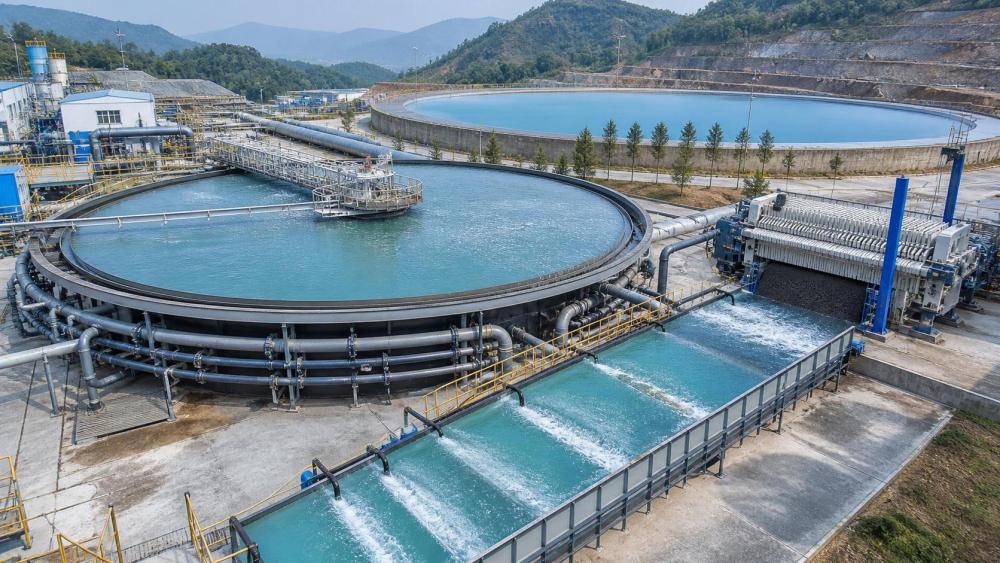
Thickening alone may be sufficient where conventional slurry disposal and a well-managed reclaim pond are available. Where water scarcity, tailings footprint, or closure planning creates stronger pressure, a second dewatering stage can recover substantially more water. The right technology depends on tailings behavior, throughput, required cake moisture, operating flexibility, and the quality standard for recovered water.
For example, pressure filtration can produce a relatively dry cake suitable for dry stacking or co-disposal, but it requires consistent feed properties, reliable cloth washing, and a handling system designed for the cake’s actual moisture and stickiness. Vacuum filtration may suit certain materials and capacities but can be sensitive to air leakage and filter media condition. Decanter centrifuges provide compact, continuous solids separation in some applications, particularly where fine solids and sludge-like streams must be managed, though polymer demand, wear, and energy use must be considered.
Do not judge equipment only by nominal throughput or cake dryness. Ask operational questions:
- How much water remains in the cake after accounting for wash cycles and cleaning?
- Can the unit tolerate shifts in particle size, clay content, and feed density?
- Does filtrate need polishing before it returns to flotation, grinding, or membrane systems?
- What happens during a filter outage: is there buffer capacity, or will the thickener become unstable?
- Can the dewatered tailings be conveyed, stacked, or blended without adding water back?
A filtration project that improves cake moisture on paper but creates frequent interruptions upstream can reduce overall water recovery. Integration matters more than an isolated performance figure.
Protect recovered water quality at the point where it becomes valuable
Tailings water recovery is not only a solids separation problem. Fine suspended solids, residual flocculant, dissolved salts, metals, sulfate, hardness, and process reagents may limit where return water can be used. Grinding circuits may tolerate water that flotation circuits do not. High-salinity water may be manageable in one process loop but harmful in another due to scaling, corrosion, or changes in reagent chemistry.
Segregating water by quality can be more effective than trying to polish every stream to the highest standard. Clear thickener overflow may be suitable for mill water, while a cleaner filtrate stream can be reserved for flotation make-up or equipment wash-down. Where fines carryover is a recurring issue, a polishing step such as self-cleaning filtration, media filtration, microfiltration, or ultrafiltration may protect downstream pumps, nozzles, membranes, and heat exchangers.
For mines facing rising dissolved solids in closed or near-closed circuits, simple clarification will not be enough. A water balance should identify salt accumulation pathways. Depending on the site, treatment may involve selective bleed management, lime softening, ion exchange, membrane systems, evaporation, or crystallization. These options require careful assessment because high-pressure membrane treatment and thermal zero liquid discharge systems are powerful tools, but they should address a verified water-quality constraint rather than compensate for poor solids separation upstream.
Common changes that backfire
One of the most common mistakes is increasing flocculant dose until overflow looks clear. This may temporarily satisfy an operator’s visual check while causing excessive reagent use, unstable underflow, filter cloth fouling, or poor filtrate quality later in the circuit. Another is raising thickener underflow density without confirming that pumps, pipelines, and downstream equipment can handle the resulting rheology.
Adding a final filter without enough surge capacity is another familiar trap. Filters cycle, cloths blind, valves require maintenance, and feed characteristics change. If the thickener has no operational buffer during these events, the entire tailings system becomes vulnerable. A recovery upgrade should include normal, upset, start-up, and shutdown conditions—not only design-point operation.
It is also risky to overlook evaporation and leakage because they are less visible than a cloudy overflow. Return-water pond losses, gland-seal water, uncontrolled sprays, overflowing sumps, and ineffective wash-water practices can add up across a year. Water accounting at these smaller points often reveals low-capital recovery opportunities.
A practical improvement sequence for plant teams
For operators seeking measurable improvement without destabilizing the process, begin with a short baseline period. Record hourly or shift-level feed rate, solids concentration, flocculant dose, overflow quality, underflow density, filter performance, recovered-water flow, and major disturbances. Include notes from the control room and field operators; they often identify the timing of valve issues, pump surging, polymer preparation problems, and changes in tailings appearance that are missing from automated trends.
Then prioritize one constraint at a time. It may be feedwell mixing, polymer quality, density control, filter cloth condition, water segregation, or return-water pumping. Make controlled changes, allow the system to reach a stable response, and compare results against the baseline. Avoid changing polymer dose, rake speed, underflow setpoint, and filter cycle simultaneously. That approach produces activity, but not learning.
The best answer to how to improve tailings water recovery is usually a disciplined combination of better settling, steadier solids handling, appropriate final dewatering, and smarter reuse of the water recovered. When those elements are balanced, operators gain more than a higher recovery percentage: they gain a tailings circuit that is calmer, easier to control, and more resilient when ore conditions or water availability change.
Related News
- How to build water ESG compliance into a wastewater reuse projectSep 17, 2026Dr. Elias Vance
- Questions to ask suppliers about water reuse system lifecycle costsSep 16, 2026Ms. Vivienne Cross
- How landfill rules affect dewatered sludge disposal costsSep 14, 2026Dr. Elias Vance
- When does energy recovery technology pay off for high-pressure pumps?Sep 13, 2026Ms. Vivienne Cross
Related News
- 00
0000-00
How to build water ESG compliance into a wastewater reuse project - 00
0000-00
Questions to ask suppliers about water reuse system lifecycle costs - 00
0000-00
How to size water filtration systems for aquaculture recirculation - 00
0000-00
How landfill rules affect dewatered sludge disposal costs - 00
0000-00
When does energy recovery technology pay off for high-pressure pumps?
Weekly Insights
Stay ahead with our curated technology reports delivered every Monday.