Which tailings water recovery chemicals perform best under high solids?




Under high-solids tailings conditions, the strongest chemical program is usually a staged combination rather than a single product: a charge-neutralizing coagulant where fine colloids are highly stable, followed by a high-molecular-weight flocculant selected for the slurry’s mineralogy and shear environment. The preferred chemistry changes when clay content, process-water salinity, pH, temperature, residual reagents, and particle-size distribution change. A polymer that produces rapid settling in a clean-cylinder test may still give poor overflow clarity, fragile flocs, excessive filter-cloth blinding, or unstable thickener operation at plant scale.
For most dense mineral slurries, anionic polyacrylamide flocculants perform best when the solids are predominantly silicate, quartz, many oxide minerals, or negatively charged gangue particles at normal alkaline process conditions. Cationic or amphoteric flocculants may perform better where fines carry a stronger negative surface charge, where clay dominates the feed, or where prior treatment leaves dispersed particles that do not respond adequately to anionic products. Coagulants such as inorganic metal salts, polyamines, polyDADMAC, and related low-molecular-weight cationic products can be valuable before flocculation, but they are rarely a direct substitute for a properly selected flocculant in high-throughput tailings thickening.
Start with the solids, not the chemical label
“High solids” can describe very different operating conditions. A coarse tailings stream with a modest fraction of ultrafines may settle readily at high slurry density. A lower-density stream containing clays, weathered ore, fine sulfides, or flotation slimes can be far more difficult to clarify. Chemical selection should therefore begin with a representative feed characterization program that captures both normal and difficult operating periods.
The most useful inputs are particle-size distribution, solids concentration, mineral composition, pH, conductivity, dissolved calcium and magnesium, alkalinity, residual flotation reagents, and the proportion of particles below roughly a few microns. Clay minerals deserve particular attention. Montmorillonite, kaolinite, illite, and mixed-layer clays can consume polymer, form highly hydrated structures, and create low-density flocs that trap water. Fine iron oxides, talc, graphite, and residual organic collectors may also alter surface behavior enough to change the preferred charge type.
Process water must be sampled with the solids. Recycled water can accumulate dissolved salts, reagents, degradation products, and suspended fines. A flocculant chosen with fresh water may behave differently after the return-water circuit reaches steady state. Where seawater or brackish make-up water is used, ionic strength and divalent ions can compress electrical double layers and change both coagulation demand and polymer conformation. The resulting effect may be favorable in one ore and harmful in another, so assumptions based solely on water salinity are unreliable.
How the main chemical families compare
High-molecular-weight anionic flocculants remain the practical starting point for many tailings water recovery duties because polymer bridging can create large aggregates at relatively low active dosage. Molecular weight supports bridge formation, while charge density influences adsorption and the polymer’s configuration in the slurry. A very high charge density is not inherently better. On some feeds it can adsorb too rapidly onto limited surface area, leaving short bridges and compact flocs that settle poorly. On other feeds, insufficient charge can leave fines dispersed and increase overflow turbidity.
Low-charge, medium-charge, and high-charge anionic grades should be screened as a family rather than treated as interchangeable. The initial screen should also include molecular-weight variation. A grade that gives the fastest interface settling is not necessarily the best choice if it produces a weak bed, high rake torque, cloudy supernatant, or poor water release in filtration.
When coagulant plus flocculant outperforms flocculant alone
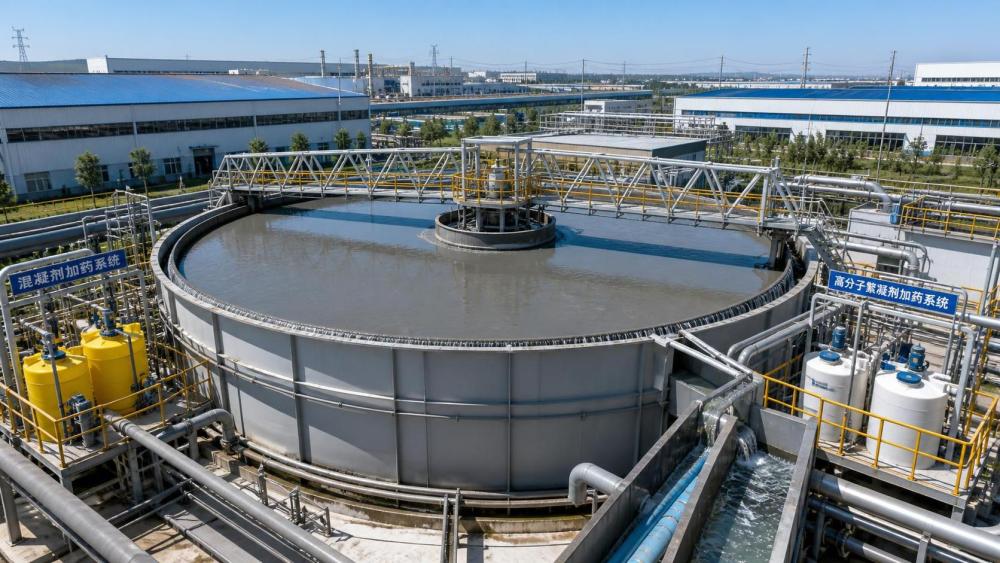
A coagulant-first approach is often justified when the slurry contains stable ultrafines that resist bridging. Inorganic coagulants can reduce the electrical repulsion between particles. Organic cationic coagulants can provide the same general function at lower addition volumes, subject to compatibility testing. After controlled destabilization, a bridging flocculant builds settleable aggregates and supports rapid solids-liquid separation.
This sequence is particularly relevant when overflow clarity is a limiting requirement for reuse, downstream membrane protection, gland sealing water, or sensitive process equipment. It can also be useful when the tailings feed swings between distinct ore zones. However, coagulant addition introduces another control variable. Overdosing can reverse charge, create small dense particles, increase soluble residuals, or force additional pH adjustment. A program that improves a settling test but raises downstream filtration resistance should not be considered successful.
Where sulfate-bearing or acid-generating materials are present, metal-salt coagulants require additional scrutiny because they can affect pH and dissolved-metal management. Alum, ferric salts, lime, and other conditioning materials may be technically appropriate in specific circuits, but they should be evaluated as part of the total water balance and solids-disposal chemistry rather than as isolated clarifiers.
Floc quality matters as much as settling rate
Tailings water recovery is commonly judged by bed settling rate and supernatant appearance, yet high-solids operation places equal importance on floc structure. A floc must survive transport from the injection point to the feedwell, distribute through the thickener without breaking apart, compact under compression, and release water during filtration or paste formation. Large visible flocs can be misleading if they collapse under rake shear or retain excessive interstitial water.
The most useful test sequence combines bench screening with equipment-relevant validation. Jar tests and graduated-cylinder settling tests are suitable for identifying obvious charge and dosage ranges, but they cannot reproduce feedwell turbulence, bed compression, rake action, or filter-feed pumping. A controlled dynamic test, pilot thickener, or side-stream trial should examine at least the following operating responses:
- Overflow turbidity and suspended solids after realistic residence time, including behavior after a feed interruption or density swing.
- Settling profile and interface movement, rather than a single timed reading that hides late-stage compression behavior.
- Underflow density at stable torque and rake speed, with observation of bed consistency and any tendency toward rat-holing or sanding.
- Filtration response: cake formation, filtrate clarity, cloth release, wash-water demand, and any change in filter-cycle stability.
- Polymer make-down quality after storage and transfer through the actual dilution-water system.
For filter presses, vacuum filters, belt filters, decanter centrifuges, and paste thickeners, the preferred tailings water recovery chemicals may differ from the thickener-only optimum. A flocculant that creates a very open aggregate may accelerate drainage but produce a low-density cake. A tighter aggregate may raise cake solids while restricting water flow. This trade-off is specific to equipment configuration, pressure profile, cloth or media selection, and slurry rheology.
Application conditions can decide the outcome
Polymer selection cannot compensate for poor preparation or injection. Dry polyacrylamide products require controlled wetting, adequate aging, and gentle agitation to avoid fisheyes and incomplete dissolution. Emulsions require correct inversion conditions. In either format, solution concentration, water quality, aging time, and transfer-pump shear must stay within the chemical supplier’s operating range. Excessive shear can shorten polymer chains and reduce bridging performance before the product reaches the thickener.
Dilution immediately before injection is often necessary to distribute polymer across a dense slurry. If the solution is too concentrated, it can contact a limited portion of the solids and create localized, oversized flocs while untreated fines pass through. If it is too dilute or injected too far upstream, prolonged turbulence can damage the developing floc. The injection point should provide rapid initial contact followed by low-shear maturation. Feedwell geometry, feed velocity, and mixing energy therefore belong in the chemical evaluation.
Make-up water deserves the same attention as process water. High hardness, extreme pH, residual oxidants, or suspended solids in dilution water can affect polymer activation and performance. A trial should record the actual water source used for polymer make-down. Switching from treated water to raw reclaim water without retesting can explain abrupt changes in settling even when the delivered chemical grade has not changed.
Common selection errors in dense tailings circuits
One frequent error is choosing on the basis of lowest dosage alone. Active chemical consumption is only one part of the cost. A lower-dose product can be more expensive in operation if it reduces water recovery, causes unstable thickener underflow, increases filter cycle time, or requires more frequent cleaning of downstream screens and filters. Conversely, a chemistry with higher consumption may be justified where it produces clearer recovered water and more consistent dewatering, provided it does not create a new water-quality constraint.
Another error is testing a single composite sample. Composite testing can hide the short periods that drive overflow excursions, torque spikes, or filter upsets. Samples should include hard-to-treat material, high-clay periods, changing flotation reagent conditions, and anticipated seasonal water-temperature variation where relevant. The final selection should be robust across the expected feed envelope, not optimized for an average that rarely occurs in operation.
Charge terminology is also often oversimplified. A product described as anionic, cationic, or nonionic does not define its complete behavior. Molecular weight, charge distribution, hydrolysis level, formulation, dissolution quality, and interaction with dissolved ions all influence performance. Comparing only broad chemical classes can eliminate useful candidates before meaningful testing begins.
A practical basis for choosing among candidates
Begin with a broad but disciplined laboratory screen: several anionic molecular-weight and charge-density combinations, selected cationic or amphoteric grades where mineralogy indicates a need, and a coagulant-plus-flocculant sequence for the most dispersive feeds. Keep mixing energy, solution age, dilution ratio, and sample temperature controlled. Record the full dose-response curve instead of selecting from one trial point.
Shortlist candidates using multiple responses: recovered-water clarity, solids capture, settling and compression behavior, achievable underflow density, and downstream dewatering compatibility. Then confirm that the chemistry can be delivered reliably in the intended format. Bulk storage capacity, dry-product handling, emulsion inversion equipment, dust control, winterization, chemical transfer distances, and available dilution water can all affect the practical choice.
The best-performing tailings water recovery chemicals under high solids are therefore those that form durable, drainable flocs at the actual plant feed condition while maintaining clear overflow and stable downstream operation. In many circuits that result comes from a properly applied anionic flocculant. Where ultrafines, clay dispersion, or variable water chemistry dominate, a staged coagulant and flocculant program, or a tailored amphoteric chemistry, may provide the more dependable operating window.
Related News
- How to build water ESG compliance into a wastewater reuse projectSep 17, 2026Dr. Elias Vance
- Questions to ask suppliers about water reuse system lifecycle costsSep 16, 2026Ms. Vivienne Cross
- How landfill rules affect dewatered sludge disposal costsSep 14, 2026Dr. Elias Vance
- When does energy recovery technology pay off for high-pressure pumps?Sep 13, 2026Ms. Vivienne Cross
Related News
- 00
0000-00
How to build water ESG compliance into a wastewater reuse project - 00
0000-00
Questions to ask suppliers about water reuse system lifecycle costs - 00
0000-00
How to size water filtration systems for aquaculture recirculation - 00
0000-00
How landfill rules affect dewatered sludge disposal costs - 00
0000-00
When does energy recovery technology pay off for high-pressure pumps?
Weekly Insights
Stay ahead with our curated technology reports delivered every Monday.